
200 Years of Photography: Why Our Past Matters
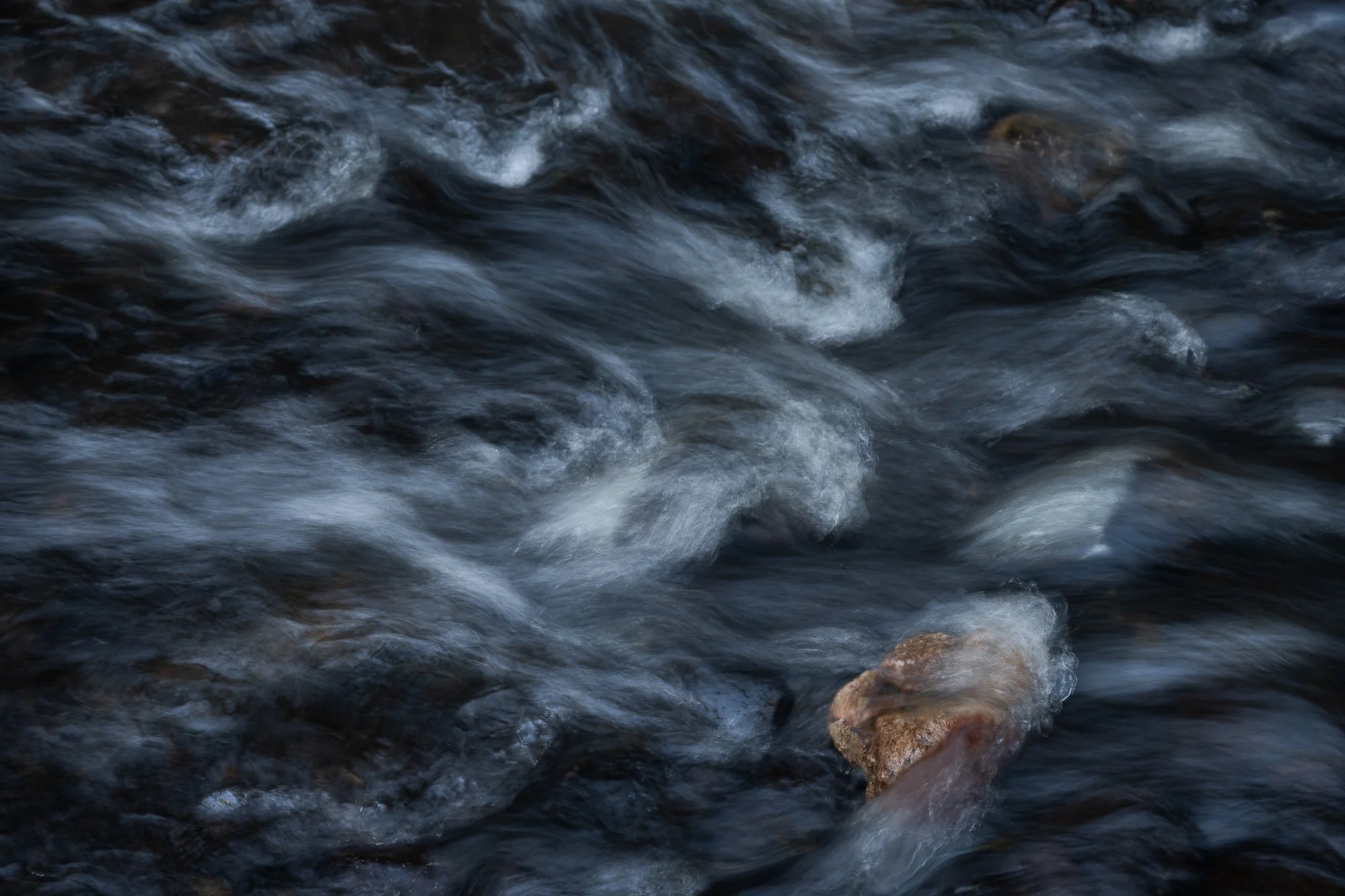
A few weeks ago, I was blissfully standing along the edge of the East Fork Jemez River in New Mexico happily clicking the shutter of my camera creating photographs similar to the composition you see below. One at a short shutter speed, then longer, and even longer still. I swapped the placement of my camera from horizontal to vertical and slightly shifted my tripod head a couple of times to place the rock in a different location in the frame and then, finally I moved my tripod to deliver a slightly different composition altogether and continued to click. In a matter of 10 minutes, I created 32 images. This got me thinking about the oldest surviving permanent photograph made with a camera. It took 8 hours to create. Can you imagine that just 200 years ago, it took hours to create one photograph when today, we can create hundreds within minutes… It’s a profound thought, isn’t it.
The years 2026 and 2027 bring us to an extraordinary milestone marking the 200th anniversary since the creation of the world’s first photograph, the oldest surviving permanent photograph made with a camera. I realized as I started to share this monumental bit of information that not many people were actually aware of this milestone. So, I thought it incredibly relevant to share a historic milestone within photography that is particularly relevant right now as we also approach World Photography Day, August 19, 2026.
To be quite candid, I had to force myself to learn the history of photography.
That statement may seem like an odd admission from someone who has built a life around photography, but history has always been my least favorite subject even though I understood the important role that history plays in many facets of our lives.
I knew the History of Photography was listed as one of the classes I would be required to take at the Academy of Art University and I was actually looking forward to it. As I mentioned above, I realize the importance of knowing the history behind an art, job, or event and wanted to be more knowledgeable. Taking a class through a university would push me to dig deep, do research, hold myself to tasks and deadlines, and gain a deeper connection to my craft, my passion, my hobby, my profession. I couldn’t be more grateful for the eye-opening and thought-provoking experience. It’s what connected the dots and inspired the reflection above.
The years 2026 and 2027 bring us to an extraordinary milestone marking the 200th anniversary since the creation of the world’s first photograph, the oldest surviving permanent photograph made with a camera. Why do we see many articles noting two different years? Let’s dig into that a bit.
The Photograph that Started it All
Around 1826 or 1827, French inventor Joseph Nicéphore Niépce created View from the Window at Le Gras, an image now widely recognized as the oldest surviving photograph made with a camera. It was the result of 10 years of research and eight-hours of exposure time.
The photograph depicts the view from an upstairs window at Niépce’s estate in Saint-Loup-de-Varennes, France. By contemporary standards, it’s not a particularly remarkable scene. There are buildings, rooftops, trees, and sky. There’s no dramatic light, decisive moment, or carefully arranged composition.
Its significance lies not in what Niépce photographed, but in the fact that he managed to photograph it at all. He spent years searching for a way to permanently capture an image produced by light. Earlier experiments with the camera obscura allowed images to be projected onto a surface, and scientists already understood that certain materials reacted to light. The challenge was making that image lasting and permanent.
Niépce eventually developed a process he called heliography, or “sun writing.” Using a light-sensitive substance applied to a plate, he was able to create an image that remained after exposure rather than disappearing.
The process was anything but instantaneous. View from the Window at Le Gras required an exposure lasting many hours. The uncertainty of the year in which it was invented stems from Niépce’s lack of precise documentation about when the photograph was created. As a result, historians generally date View from the Window at Le Gras to either 1826 or 1827. It now exists in the Gernsheim collection at the University of Texas in Austin.
Since then, the medium emerged through decades of experimentation, discoveries, failures, improvements, and contributions from multiple inventors.
I must note that there is a long and somewhat blurred history of images that were created previous to this one. Failed attempts and temporary images that didn’t last. For example, I learned there is a belief that Niépce created a heliograph of an engraving of Pope Pius VII in 1822 that was since destroyed so historians don’t count it since the first historic photograph must currently exist in the real world.
As historians have officially noted either 1826 or 1827 as the general timeframe in which the first (still existing) photograph was made, there are many different events happening all around the world both in 2026 and 2027 celebrating and honoring the 200-year anniversary.
France is preparing one of the most notably ambitious celebrations of photography ever staged, with a year-long bicentenary program running from September 2026 to September 2027 to mark two centuries since the medium's invention. Whereas places like Santa Fe are hosting a city-wide celebration of photography’s 200th anniversary in 2027. I highly recommend finding ways to take part in some of the celebrations or host one on your own.
From Hours to Fractions of a Second
It is difficult to comprehend how dramatically photography has changed in two centuries. Niépce needed hours to record the view outside his window. Today, a photographer can make an exposure in 1/8000th of a second. Modern cameras can photograph scenes in extraordinarily low light, focus on moving subjects with remarkable accuracy, record dozens of frames every second, and produce files containing extraordinary amounts of visual information.
Think about that for a moment...
Today, we carry cameras capable of making photographs at 1/8000th of a second. We can photograph in near darkness, capture dozens of frames in a second, instantly review an image, and make thousands of photographs without ever changing a roll of film or mixing a chemical. And it all traces back to people who believed it important to experiment with light, chemistry, materials, and an idea that must have seemed almost impossible at the time.
We can immediately review what we’ve made, examine a histogram, adjust exposure, change ISO, recompose, and try again. We can delete and shoot again and rarely give any of that a second thought.
Photography has become so accessible that most people now carry a remarkably sophisticated camera in their pocket everywhere they go. Billions of photographs can be made (and are made), edited, and distributed around the world almost instantaneously.
That reality makes Niépce’s experiment even more remarkable.
Understanding Where Our Work Fits
There is another reason I believe artists benefit from understanding the history of our craft: our work does not exist in isolation. Every photograph we make is influenced, consciously or unconsciously, by nearly two centuries of photographic imagery and funnels of created content.
As landscape photographers, we work within traditions shaped by generations of photographers who explored wilderness, place, scale, conservation, beauty, destruction, and humanity’s relationship with the natural world. Portrait photographers inherit visual conventions that stretch back through photographic portraiture and centuries of painted portraits before it. Documentary, street, fine-art, architectural, wildlife, and abstract photography all have histories that continue to influence how images are made and interpreted today.
Understanding those histories doesn't mean we need to imitate the photographers who came before us. Quite the opposite. Knowing what has already been explored can help us recognize what we want to continue, what we want to question, and what we might choose to do differently. It gives our own work context. History doesn't tell us what we should create, it gives us a larger foundation from which to create.
“History doesn’t tell us what we should create, it gives us a larger foundation from which to create.”
Two Hundred Years Later
As I sit here in my studio pecking away at my laptop, I can’t help but look around in awe at all the photographic items that surround me, the digital equipment, the variety of prints on different mediums, cyanotype experiments, the fancy Canon printer, my collection of photography books, and more. It’s hard to imagine a time where it took 8 hours to create one image.
There is something remarkable about imagining Niépce standing near that window approximately 200 years ago, waiting for light to slowly create an image on a prepared plate. He could not have known what photography would become. He couldn't have imagined digital cameras, smartphones, satellites, underwater photography, photographs from the surface of Mars, or billions of images circulating around the world every day. From Niépce's heliography to digital images, photography began, much as it continues today, through curiosity, trial and error, learning, and experimenting. Yet the fundamental idea remains surprisingly similar.
Light enters. a surface records it, a moment, place, person, or idea becomes an image, and someone else gets to see what we saw.
Perhaps that is what finally made photographic history interesting to me. I stopped seeing it as subject I dread and began seeing it as a conversation, a reflection, and consideration. It’s a conversation that began long before any of us picked up a camera, and it will continue long after we're gone.
As photography reaches roughly its 200th anniversary and as we celebrate World Photography Day, it seems like a particularly good moment to look backward, not simply to celebrate how far the medium has come, but to understand the foundation beneath the work we're creating today and become a little more thoughtful about where we take it next.